

If you know me, you already know I’m neither Latino nor Hispanic. So, why am I addressing this subject? First, because truth matters. Second, because bloodlines & nationality matter. I invite everyone to read this as part of further study and consideration, and I especially look forward to seeing comments from anyone who identifies with the groups mentioned above. With that being said, let’s dive in:
Lately, there’s been an increasing focus on Afro-Latinos and Afro-Hispanics (aka Blacks, Negores), which is a positive trend as more people rediscover their history and heritage. However, we’re hearing far less about Euro-Latinos and Euro-Hispanics (aka Whites) —though that too is gradually coming into the light.
Rather than delving too deeply into the subject myself, I’ll share several videos, as we close this out, offering diverse perspectives. That said, I want to highlight some key points about the terms “Latinos” and “Hispanics,” as well as the dynamics of Afro-Latinos and Afro-Hispanics living among Euro-Latinos and Euro-Hispanics.
Rediscovering Identity: Latinos, Hispanics, and the Complexities of Bloodlines
The terms “Latino” and “Hispanic” are more than just labels—they are bywords that encapsulate centuries of history, colonization, migration, and identity. Yet, these terms are often misunderstood and oversimplified, masking the diversity of the people they represent. So, let us explore the layers of meaning behind these terms, focusing particularly on Afro-Latinos, Afro-Hispanics, and their relationship with Euro-Latinos and Euro-Hispanics.
The Roots of “Latino” and “Hispanic”
The term “Latino” is generally used to describe people from Latin America, while “Hispanic” refers to those with a connection to Spanish-speaking countries. At first glance, these definitions seem straightforward, but they fail to capture the intricate bloodlines, cultures, and histories of the people they represent.
For instance, the word “Hispanic” has its origins in Hispania, the Roman name for the Iberian Peninsula, which includes modern-day Spain and Portugal. Over time, it became associated with Spanish-speaking cultures, ignoring the indigenous, African, and other influences that define much of Latin America. Spanish is the focus for Hispanic countries, but most self-professed Hispanic people will not lead by saying that they are to be associated with Europe, even though Spain is European. Furthermore, even less self-professed Hispanic people would say that they are associated with the Roman Empire (remember it was Rome who called Spain & Portugal Hispania), despite the etymology & history of the word Hispanic:

Similarly, “Latino” encompasses a vast region with diverse ethnic groups, from Indigenous peoples to Africans to Europeans, all of whom have shaped the region’s identity. The word “Latin” itself has meaning and historical significance. It is derived from “Latium”, the name of the region in central Italy where the city of Rome was founded. The people who originally inhabited Latium were called the Latini (or Latins), and their language came to be known as Lingua Latina (the Latin language). In essence, the name “Latin” reflects its geographic and cultural origins in the land of Latium. Over time, the term became synonymous with the language, culture, and influence of Rome. But again, most self-professing Latinos do not lead by saying that they are European or Roman, despite the etymology & history of the word Latin:

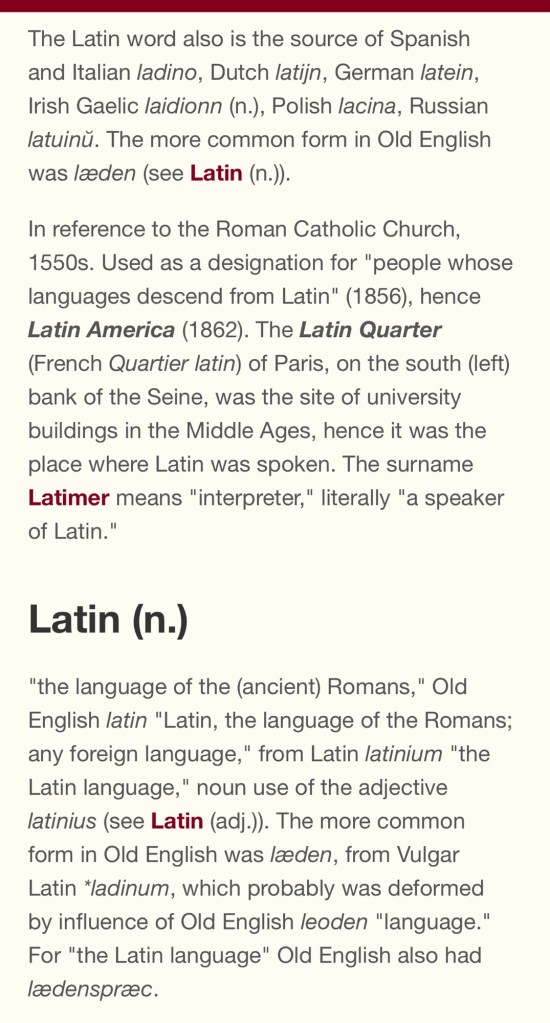
A little additional European language insight before moving on: Latin is the root language from which the “Romance languages” evolved. Many people mistakenly believe that “Romance languages” are so named because they are associated with romantic notions, such as love and passion, often linked to languages like French and Italian. However, the term actually comes from the Latin word “Romanicus,” meaning “Roman.” These languages evolved from Vulgar Latin, the spoken language of the Roman Empire, not from any romantic connotations. Romance languages share similarities in vocabulary, grammar, and syntax.
Here’s another interesting fact: if you’re a citizen of a country where Spanish, Portuguese, French, or Italian (which are again all Romance languages), is an official or national language, you might also be considered “Latin” in a broader sense. This label applies not only to Latin America but also to countries in Africa and regions like Quebec, Canada, due to colonialism and shared linguistic roots. This highlights the complexity of identity labels and their multiple applications.
Afro-Latinos and Afro-Hispanics: A Hidden History
Afro-Latinos and Afro-Hispanics (Negros) are people of African descent who developed roots in Latin America or Spanish-speaking countries. Despite their significant contributions to commerce and technology, music, medicine, cuisine, and other cultural and historical achievements within the Western hemisphere, their stories have — until more recently — been overlooked or erased.
Today, there is a growing movement to reclaim, highlight, and celebrate Afro-Latino and Afro-Hispanic identities. This resurgence is not just about recognition and reclamation—it’s about honoring the resilience and legacy of African ancestors who endured colonization and slavery, and strengthening perseverance despite ongoing disenfranchisement in the lands they now call home. It’s about affirming that the “Afro” (African, or for many, “Negro”) part is the vital component of their identity, regardless of the American country of their current citizenship, no matter how it has been hidden, often times, in plain sight.
Euro-Latinos and Euro-Hispanics: A Quietly Strong Presence
The European bloodlines of Euro-Latinos & Euro-Hispanics are also seldom discussed, but the conversations are increasing as well. These individuals, of predominantly European descent, have families who came willingly and enthusiastically from Europe to the Americas during and after colonization. While their heritage and mindsets still align closely with Europeans, they claim both distance and closeness when it’s advantageous to do so. They are part of the fabric of Latino and Hispanic identity, and they embody it, just as European Americans are the face of the USA.
Their experiences, however, have historically been shaped by racist privilege and power dynamics that favored Europeans since the times of colonization. This historical context has continuously fueled disparity and injustice between Euro-Latinos/Euro-Hispanics and Afro-Latinos/Afro-Hispanics, as well as Indigenous communities (of course), creating a legacy of inequality that persists today—one that few outside their borders know or consider.
The Power of Bywords
The bywords “Latino” and “Hispanic” often homogenize these diverse groups, erasing their national origin and bloodline. This is why it’s essential to use these terms with understanding, recognizing the people behind the labels. The plight of the Afro, or better yet, the plight of the Negro, is highly significant wherever we are found and whatever language we speak. It’s a marker, according to Deuteronomy chapter 28 verses 37 & 46; we delve much deeper into what that means in other blogs, such as the series linked at the end.
When we talk about Afro-Latinos and Afro-Hispanics (Negroes), we must remember that their identities are not just a subset of Latino or Hispanic culture—their identities are central to their culture and future. Similarly, acknowledging the role of Euro-Latinos and Euro-Hispanics requires us to confront the colonial past that shaped the region’s social and racial hierarchies, and also their futures.
Furthering Understanding
As you continue to research and rediscover the rich history of Afro-Latinos & Afro-Hispanics, it is essential to approach your findings with humility and a steadfast commitment to truth. This truth journey is not about arbitrarily dividing people into categories, but rather about understanding the complexities of the past, present, and future with honesty and integrity. It is about acknowledging and addressing historical discrepancies & injustices, recognizing that when we know better, we have the responsibility to do, think, and teach better.
In the end, bloodlines & nationalities hold profound significance because they remind us of our origins and the responsibilities tied to them. They anchor us to historical and lasting covenants, providing a solid foundation to move forward with clarity, purpose, and direction. Therefore, let us continue to uncover the truth—not only about the misinformation and falsehoods surrounding these topics but also about those who orchestrate the cover-ups and the motives behind the lies that are perpetuated and embraced. It is time to step boldly into the truth of all matters!
I encourage you to read through my first blog series for a deeper dive into the “name game” that has been imposed on the so-called Negro.
As I mentioned earlier, here are some videos that explore various topics concerning Afro & Euro Latinos & Hispanics. Please note that the opinions expressed in these videos are theirs, and theirs alone.
Until next time, shalom ✌🏾
~Yahrahn
Like, comment, share, and subscribe
If you would like to donate:
Cash App: $Yahrahn https://cash.app/$Yahrahn
PayPal: @Yahrahn https://www.paypal.me/Yahrahn
