

Bottom Line Up Front (BLUF): The Feast (or better yet, the festival) of Purim is not one of the commanded feasts of The Most High YAH; however, we can choose to observe it as a memorial festival, by celebrating YAH’s salvation. Regardless of whether you keep the feast or not, all Bible believers, should understand the significance of Purim.
The Festival of Purim, or in English — the Festival of Lots (https://biblehub.com/hebrew/6332.htm) — is a remarkable celebration of YAH’s providence and deliverance. Rooted in the events recorded in the Biblical book of Esther, the Festival of Purim reminds us of how YAH works to protect His people, sometimes in unforeseen or unseen ways. Let us explore the significance of Purim and talk about some practical, Biblical ways to celebrate the ancient feast today. Alright, let’s get into it:
What and who is the Festival of Purim about?
Before we dive in, let’s establish who the central figure of the Book of Esther is—Hadassah, also known as Esther. She was a Hebrew Israelite orphan who was then raised (like a daughter) by her cousin Mordecai, and she later became the queen of Persia. It’s important to not forget that she was of Hebrew Israelite heritage, and since Esther is not a Hebrew name, we will principally refer to her by her original Hebrew name—Hadassah (הֲדַסָּה) https://biblehub.com/hebrew/1919.htm
“Mordecai had a cousin, Esther, whose Hebrew name was Hadassah; she was a beautiful young woman, and she had a good figure. After the death of her parents, Mordecai had adopted her and brought her up as his own daughter.”
Hadassah (Esther) 2:7
Alright, now we are really ready to find out what the Festival of Purim is:
1. Historical Background — The Book of Hadassah (Esther)
The Festival of Purim commemorates the miraculous deliverance of the Yahudim (Hebrew Israelites of the Southern Israelite Kingdom of Yahudah aka Judah https://biblehub.com/hebrew/3064.htm) people during the reign of King Ahasuerus (Xerxes I) of Persia. Haman, a high-ranking official and close advisor of King Ahasuerus, was an Agagite (likely an Amalekite — making him a descendant of Esau), who devised a plan to utterly destroy the Yahudim people, primarily because Mordecai (a Yahudi—Israelite) refused to bow to him. So Haman cast “lots” (called “purim” in Hebrew) to determine the date to begin the genocide of the Yahudim.
Through the courage and faith of Mordecai and Queen Hadassah (Esther), YAH orchestrated the deliverance of His chosen people. Here is a quick order of events:
- Haman plotted to persuade the King of Persia to legalize and decree the genocide of all Yahudim within the Persian Empire; his motive stemmed from both the long-standing enmity between the Amalekites and Yisrael, and his personal anger when Mordecai, in obedience to YAH’s commands, refused to bow and worship Haman, despite the Kings command. See Esther 3:2.
- Hadassah, (a Yahudi Hebrew Israelite) who became the queen & wife of the king in Persia, risked her life by coming before the king, revealing her identity, exposing Haman’s evil plot, and saving her people. Esther 2:7, 17; 4:11; 5:1-2; 7:3-6; 8:5-12.
- Haman was executed on the very gallows (a hanging pole) that he had prepared for Mordecai, the Yahudi. Esther 7:9-10.
- The king issued a decree allowing the Yahudim to legally defend & avenge themselves, leading to a great victory over their enemies. Esther 8:11; 9:1-5.
NOTE: Though The Most High is not mentioned by name in the book of Esther, His invisible hand is evident throughout the story. This demonstrates YAH’s sovereign power and His ability to work (seemingly) behind the scenes for His people’s good. (Much more on that is added below after the close of this blog). Also, if you read the book The Additions to Esther, which is found in the Apocrypha, you will see the name of YAH mentioned, as well as a lot of other details.
2. Why is Purim Celebrated?
The celebration was instituted by Mordecai and Queen Hadassah (Esther) to mark the days of Israelite deliverance. In Esther 9:20-22, they established Purim as an annual festival of joy, thanksgiving, and gift-giving, to commemorate YAH’s great deliverance.
“Mordecai recorded these events and sent letters to all the Yahudim in all the provinces of King Ahasuerus (Xerxes), both near and far, to establish among them an annual celebration on the fourteenth and fifteenth days of the month of Adar as the days on which the Yahudim gained rest from their enemies and the month in which their sorrow turned to joy and their mourning into celebration. He wrote that these were to be days of feasting and joy, of sending gifts to one another and to the poor.”
Esther (Hadassah) 9:20-22
3. Purim Also Points to the Ongoing and Future Salvation of YAH
The Festival of Purim not only reminds us of the salvation of YAH during Mordecai & Hadassah’s time, but it also encourages us to obediently and patiently endure any hardships today and in the times to come, knowing that the salvation of YAH is for those of us who remain courageous & steadfast in Him — HalleluYAH! The Messiah’s true and Hebrew name directly translates into “YAH’s salvation” because Yahoshua is The Salvation of YAH! And we know He is coming to deliver us out of the hands of our enemies, as well as the curses of sin & death!
The Messiah’s name Yahoshua (יהושע) is a Hebrew name that means “YAH is salvation” or “YAH delivers”.
His name is composed of two parts:
1. “YAH” (יָהּ) – A shortened form of YHWH (יהוה), the sacred Name of Elohim.
2. “Hoshea” (הוֹשִׁעַ) – Derived from the root “yasha” (יָשַׁע), meaning “to save, deliver, rescue.”
Thus, “Yahoshua” carries the meaning that YAH is the one who brings salvation and deliverance. His name and purpose are significant because they reflect the mission of Yahoshua HaMashiach (The Messiah), who came to bring salvation & deliverance to His people, review Matthew 1:21, Isaiah 61:1, Luke 4:18-19, Hebrews 2:14-15, 1 Thessalonians 1:10, Romans 5:9-10, and Revelation 21:3-4.
As we keep the feast of Purim, we must always remember the past while looking forward to the future, anticipating Revelation 19:11-21, when all will see Yahoshua HaMashiach, our sword-wielding, all-conquering King, as He returns to execute judgment and deliver His people once and for all. In a similar way to Hanukkah (the other winter feast that is not a commanded observance), the winter festival of Purim offers a glimpse of YAH’s salvation, which comes through the sword & warfare—the divine execution of righteous judgment & justice. For more on Hanukkah, check out this series: https://whatishebrewing.com/2023/12/02/the-hanukkah-is-blog-series/
Let us not forget the words of Matthew 11:12: “… The Kingdom of Heaven suffers violence, and the violent take it by force.” This is not merely a spiritual battle, nor solely a physical one—it is both.
How to Celebrate Purim Biblically—Today
Celebrating the Festival of Purim today can be meaningful, IF we align our observance with Biblical understanding. Here are practical ways to remember and keep this festival:
1. Read the Book of Esther (Hadassah’s Story)
A central part of celebrating Purim is reading the book of Hadassah (Esther). The annual reading of the story allows us to reflect on YAH’s faithfulness and His power to deliver His people when they call out to Him in faith through sincere prayer & fasting. Consider reading it aloud with family or in a community gathering. As you read, focus on how YAH used Mordicai’s & Hadassah’s courage and faith to bring about His plans.
2. Offer Up Praise & Prayers of Gratitude
Pray to and praise YAH for His deliverance, both for the history of Purim and for your personal life. Recognize YAH’s hidden hand guiding and protecting you, just as He did for Mordecai, Hadassah, and all of the Yahudim in the Persian Empire.
3. Feast & Rejoice — It’s a great time to party — just say no, to party-poopers.
In Hadassah (Esther) 9:22, Mordecai instructed the Yahudim to observe Purim with “days of feasting and gladness.” Host a celebratory meal with family and friends, turn up the music, dance and praise YAH, enjoy the fellowship, and make new memories. This festival is a reminder of the joy YAH’s people felt when their sorrow turned to gladness. Consider other times when we see that sentiment:
“… Weeping may endure for a night, But joy comes in the morning.”
Psalms 30:5 “YAH is my strength and my song, and He has become my salvation. He is my Elohim (God), and I will praise Him, my father’s Elohim, and I will exalt Him.”
Exodus 15:2 “Then Nehemiah told them, “Go and eat what is rich, drink what is sweet, and send out portions to those who have nothing prepared, since today is holy (set apart) to YAH. Do NOT grieve, for the joy of YAH is your strength.””
Nehemiah 8:10 “You prepare a table [picture a banquet table of feasting] before me in the presence of my enemies. You anoint my head with oil; my cup overflows.”
Psalms 23:5
4. Give Gifts & Help the Needy, and Visit Those Whom You Haven’t Seen For A While
Following the example and instruction in Hadassah (Esther) 9:22, give gifts of food to loved ones and provide for those in need amongst your people. This practice fosters community, generosity, and love for others, reflecting the unity of YAH’s people during Purim.
“For there will never cease to be poor in the land; that is why I am commanding you to open wide your hand to your brother and to the poor and needy in your land.”
Deuteronomy 15:11“When you give to the poor, it is like lending to YAH, and YAH will pay you back.”
Proverbs 19:17 “By this everyone will know that you are My disciples, if you love one another.”
John 13:35 “Be devoted to one another with [authentic] brotherly love [as members of one family], give preference to one another in honor; contributing to the needs of YAH’s people, pursuing [the practice of] hospitality.”
Romans 12:10, 13“Then the King will say to those on His right, ‘Come, you who are blessed by My Father, inherit the kingdom prepared for you from the foundation of the world. For I was hungry and you gave Me something to eat, I was thirsty and you gave Me something to drink, I was a stranger and you took Me in, I was naked and you clothed Me, I was sick and you looked after Me, I was in prison and you visited Me.’”
Matthew 25:34-36
5. Teach the Next Generation
Purim is a powerful opportunity to teach our children and the next generations about YAH’s faithfulness and the courage of Mordecai and Hadassah. Their obedience and trust in YAH made them vessels for deliverance, demonstrating that YAH’s hand is always at work, even in the most challenging circumstances. As we reflect on their example, we should encourage our children to trust YAH fully and to stand for His righteousness, no matter how difficult the situation may be.
“Train up a child in the way he should go, and when he is old he will not depart from it.”
Proverbs 22:6 Paraphrasing Psalm 78:4-7 — We do not hide Your teachings from our children, we declare to the generation to come the praises of YAH, and His strength and His wonders which He has done… So that our children put their trust in Elohim, and not forget the works of YAH, but keep His commandments.
6. Reflect Spiritually
Purim is not just a historical commemoration; it’s a time for spiritual reflection. The story of Mordecai & Hadassah teaches several key lessons:
• Obey YAH’s commands and trust His Sovereignty & Power: Even when YAH’s presence seems hidden—He is always at work.
• Courage in Faith: Like Mordecai & Hadassah, we are called to stand for YAH’s righteousness, even if there are threats to our lives and well-being.
• Divine Timing: YAH places us in specific circumstances for His purposes, just as Mordecai and Hadassah were placed around and in the king’s palace “… for such a time as this” (Esther 4:14).
Maintain The Biblical Focus of Purim
If you Google Purim you will likely see practices that have been dishonestly and unbiblically associated with Purim, things like wearing goofy costumes, playing nonsensical games, and other traditions created by non-Israelites who have hijacked our history and celebrations.


The Festival of Purim has NO connection to Mardi Gras, Halloween, or any other pagan holiday, so our celebration should bear NO resemblance to them whatsoever!
We must maintain our focus on Purim’s Biblical foundation & understanding. Do not incorporate ideals, traditions, and customs that distract from or go against the true meaning of the festival. By centering your celebration on YAH’s deliverance and the lessons from Mordecai & Hadassah’s story, along with the rest of Scripture, you can celebrate the Festival of Purim with righteous joy as you honor YAH and strengthen your faith.
Conclusion
The Festival of Purim is a great time of rejoicing & praising YAH for His faithfulness and providence. Through the story of Mordecai, Hadassah, and the united Yahudim people in the Persian Empire, we are reminded that YAH is always working to protect and deliver His people, even when His hand seems hidden.
By reading the book of Hadassah (Esther), praying, feasting, giving, and teaching others about YAH’s faithfulness, we can celebrate Purim in a way that is joyful, meaningful, and pleasing to YAH.
May our Festival of Purim celebrations be filled with thanksgiving, joy, and a deeper trust in YAH’s salvation!
Feel free to share this blog with others who seek to understand and/or celebrate Purim Biblically. Let us rejoice in YAH’s mighty works and His unfailing love for His people!
Until next time, shalom ✌🏾
~Yahrahn
Like, comment, share, and subscribe
If you would like to donate:
Cash App: $Yahrahn https://cash.app/$Yahrahn
PayPal: @Yahrahn https://www.paypal.me/Yahrahn
The Hidden Presence of YAH’s Name in Esther
One of the most intriguing aspects of the Book of Esther is that YAH’s name Yahuah (יהוה) does not appear explicitly in the text. However, there are strong indications that it is subtly embedded within the text. Here’s how:
1. Acrostics in the Hebrew Text
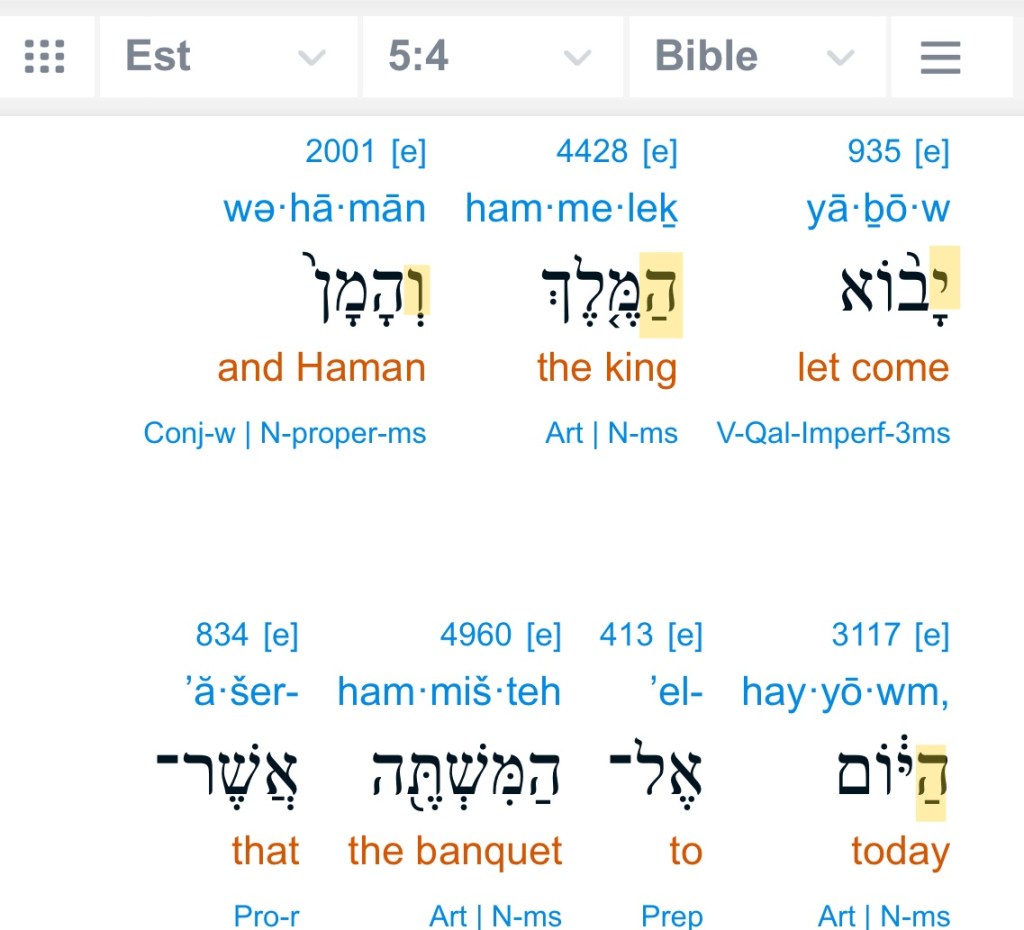
The so-called “Tetragrammaton” יהוה, (which is the full name of Yahuah, spelled with Hebrew letters), is hidden in acrostic form in several verses in the book of Esther, appearing as the initial or final letters of consecutive Hebrew words. Two notable examples include:
• Here, YAH’s name appears in reverse order, symbolizing His hidden presence. Esther 1:20:

• In this verse, YAH’s name appears in direct order, reflecting His sovereignty and active role in the unfolding events. Esther 5:4:
2. Thematic Emphasis on Hiddenness
The absence of YAH’s name, directly in the text, aligns with the theme of the book: YAH’s actions are often hidden, but undeniably present. His providence is evident in key moments, such as:
• Mordecai overhearing the assassination plot against the king.
• Hadassah being placed in the palace “for such a time as this” (Esther 4:14).
• The reversal of Haman’s plans and the triumph of the Yahudim and the Kingdom of Yahudah.
3. Faith in Divine Sovereignty
Again, though YAH’s name is not written directly in the text, the faith of Mordecai and Hadassah reflects trust in His covenant and promises. Mordecai’s statement in Esther 4:14—“relief and deliverance for the Yahudim will arise from another place”—demonstrates his confidence in YAH’s faithfulness to His people.
Why is YAH’s Name Hidden?
The concealment of YAH’s name may serve several purposes:
• To Reflect the Theme of Hidden Providence: Just as YAH’s name is hidden, so is His role in the events; this can teach us to trust His unseen hand in our lives.
• To Highlight Human Responsibility: Mordecai and Hadassah acted courageously, showing that faith requires action.
• To Possibly Mitigate Pagan Provocation: While Persian rulers were generally tolerant of other religions—evidenced by Cyrus the Great’s decree allowing the Yahudim to return and rebuild the Temple (Ezra 1:1-4)—explicit references to YAH (יהוה) may have been avoided in a royal document or historical record circulated within the Persian court to prevent political complications. Whether or not that is the case with the book of Hadassah (Esther), the text conveys YAH’s presence through the unfolding events, chapter by chapter.
All of that being said, it is important to understand that we will see Yahoshua, the visible image of the invisible YAH (Colossians 1:15, John 14:9), who will come to reign on the renewed earth (Revelation 21:1-4, Daniel 7:13-14) as the manifestation of YAH’s eternal salvation (Isaiah 49:6, Luke 2:30-32)—His mighty right hand of power (Isaiah 53:1, Psalm 98:1, Acts 7:55-56).
Ensure that you watch these Purim videos by Dr. Yoshiyahu, the Moreh (Teacher) at The Awakening Remnant Koalition (ARK):
You can also gain additional insight by reading what is known as the Additions to Esther, which can be found in the Apocrypha.
https://www.bible.com/bible/546/ESG.INTRO1.KJVAAE
https://www.bible.com/bible/69/ESG.INTRO1.GNTD
https://m.kingjamesbibleonline.org/Additions-to-Esther-Chapter-10/
To learn more about the Biblical Holidays and how to celebrate them:

2 thoughts on “The Feast of Purim & How to Celebrate Biblically Today”