
Intro: Many of Us Have Cleaned Things Up… But There’s Still More to Look Into.
As new Torah-keepers, many of us quickly make major changes and progress in obeying The Most High YAH’s dietary instructions, found in Leviticus 11 and Deuteronomy 14—most notably, we immediately stop eating pork, shellfish, and fish without fins and scales. Praise YAH for the clarity He gives us through His Word and Ruach. But our challenge for “clean eating” doesn’t end once we have chosen to only eat clean meats and no longer eat unclean meats (abominations).
We live in a time where our food is highly processed, ingredients are industrialized, hidden behind complex names, and often derived from unclean animals and bugs. This is where discernment and diligence are needed—because the goal is not just avoiding bacon or shrimp but honoring YAH fully with what we choose to consume.
This post builds off of my earlier article, “Our Creator Cares About What We Eat, How We Feast—and So Shall We” by going one level deeper: into food additives, stabilizers, dyes, and emulsifiers.
🔎 Some Hidden Ingredients Torah Keepers Must Watch For
Let’s look at just a few common examples (there are others of course but these are more common):
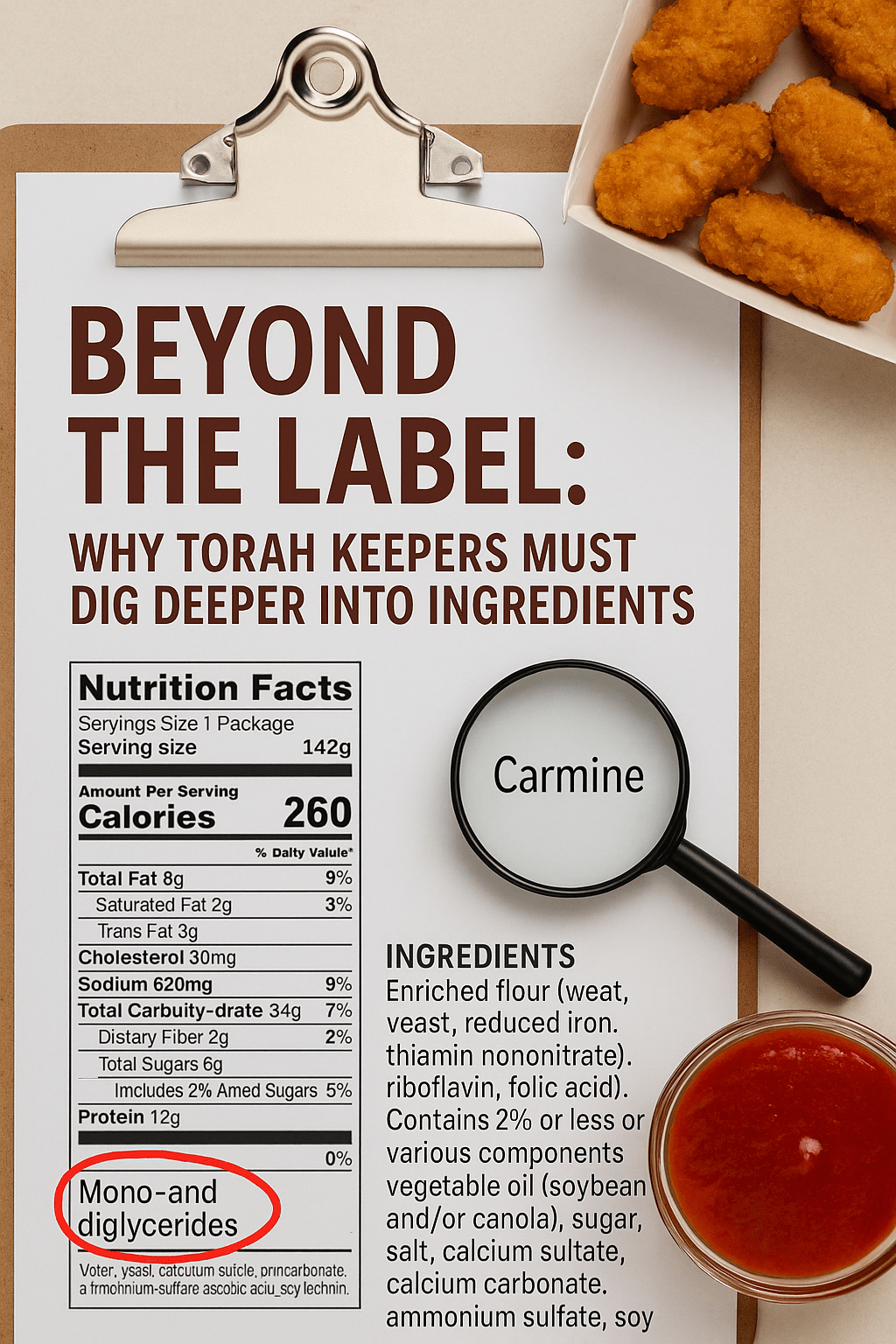
Mono- and Diglycerides
These are emulsifiers used in breads, baked goods, and even ice cream. They can be derived from plant oils or beef fat—but unfortunately, they are often sourced from pork fat unless specified otherwise.
It’s hard not to think of this verse, isn’t it?
“And יהוה said, “Even so the children of Yisra’ĕl shall eat their defiled bread among the nations, to whom I drive them.””
https://bible.com/bible/316/ezk.4.13.TS2009
Yehezqĕl (Ezekiel) 4:13 TS2009
Carmine / Cochineal Extract
A red dye made by crushing cochineal bugs, commonly added to candies, yogurts, juices, and cosmetics. Though often labeled as “natural,” this insect-based food coloring makes the product unclean for us.
Shellac / Confectioner’s Glaze
A shiny resin coating—which can be used on candies, fruit, and snacks—is made from the secretions of the lac bug.
Gelatin
Used in food, sauces, candies, gums, marshmallows, and medicine capsules. Gelatin is almost always derived from pork (porcine)—unless specifically labeled as beef (bovine), fish, or plant-based gelatin.
L-Cysteine
An amino acid used to “soften” bread dough. Many commercial sources derive it from human hair or duck feathers—but some, disturbingly, come from pig hair. Always worth verifying.
Stearic Acid / Magnesium Stearate
Often found in supplements or pills as a binding agent. It can be plant-based, but many manufacturers use animal fat—again, including pig.
Why This Matters: YAH Cares About the Details
YAH didn’t just give us dietary Commandments as arbitrary rules—they’re part of a set-apart lifestyle (Leviticus 11:44–47). He wants His people to distinguish between clean and unclean, holy and common.
Just because an ingredient is microscopic or refined doesn’t mean it no longer matters. Many of us are unknowingly compromising our obedience by consuming these hidden additives. But now that knowledge is increasing, we can act with wisdom and reverence.
Practical Steps for Torah-Based Clean Eating
✅ Read Labels Carefully – If it sounds synthetic or unfamiliar, look it up.
✅ Don’t rely on Kosher or Halal standards –they add to and diminish Torah commands.
✅ Ask Questions – Email or call the manufacturer or chef.
✅ Support Clean Brands – Once you find a trustworthy source, share it.
✅ Cook More from Scratch – The fewer processed ingredients, the easier it is to honor YAH.
Sample Email or Message to Ask Food Companies or Restaurants
You should want to know what’s in your food—you have the right to know. Most companies are willing to share that information, and when ingredient lists don’t provide the full details, it’s on us to take the initiative and ask.
Here’s a simple message you can copy, tweak, and use:
Subject: Quick Question About Ingredient Sources
Greetings,
I am reaching out to ask about the source of certain ingredients in your [product/meal]—specifically stabilizers, emulsifiers (such as mono- and diglycerides), food colorings, and any other additives.
I follow a Biblically clean diet and avoid ingredients derived from pork, shellfish, fish without both fins & scales, and insects (such as carmine/cochineal or shellac). Could you please confirm if any of your ingredients are derived from these sources?
Thank you for your time, and I appreciate your transparency in helping me make informed decisions about what I consume.
Sincerely,
[Your Name]
Choose Reverence & Obedience Over Convenience
Walking in obedience to YAH means learning, adjusting, and sometimes making inconvenient choices. But this is a narrow path—little steps matter—and YAH is pleased when we strive to honor Him in even the smallest of things.
Let us not be content with food that simply appears clean on the surface, when its hidden sources may still defile the temple of YAH (1 Corinthians 3:16–17). We are called to be a qodesh people—set apart in every area of life, including what we consume. As knowledge increases, so must our discernment and diligence. This pursuit of clean eating isn’t just about physical health—it’s about walking in set-apartness, honoring YAH in body and spirit (1 Corinthians 6:19–20), and guarding the temple He has entrusted to us.
Update:
We were previously led to believe that In-N-Out Burger’s buns were unclean due to Google search results like this…

But after I emailed In-N-Out using the sample message above, I received a call from their corporate office. A representative named Grace personally walked me through their ingredient source list in detail—and guess what? Their burger buns are clean after all, and they do not contain glycerides at all. Let this be encouragement for all of us to start reaching out to companies directly. And who knows—maybe accurate answers will eventually correct the misinformation floating around online and in our communities.

Until next time, shalom ✌🏾
~Yahrahn
Like, comment, share, and subscribe
If you would like to donate:
Cash App: $Yahrahn https://cash.app/$Yahrahn
PayPal: @Yahrahn https://www.paypal.me/Yahrahn
Other things and sources for your consideration:
Check out this PDF from The Hananiah Project, for a deeper dive not only on what we don’t eat, but importantly, what we can & should eat!https://www.hananiahproject.com/_files/ugd/f1344a_ea2bd301c3884cebb2ee3bf849a1186d.pdf

2 thoughts on “Beyond the Label: Why Torah Keepers Must Dig Deeper Into Ingredients”