When it comes to keeping The Most High’s Biblical calendar, there are many opinions out there these days. Some start the year with a dark moon, some on the equinox, some follow fixed date calendars, some just follow the ways of their teachers & assemblies because they don’t understand it for themselves. Before we go any further, I’ll share my quick opinion—no matter where you stand, I’m glad to see the growing number of people who are trying to return to our Father’s calendar. Even if we miss the exact timing, it’s far better to seek and try to get on YAH’s time than to ignore it and live by the calendars of Rome, Babylon, Egypt, or the USA.
Alright, now, let’s get into this huge topic and I assure you, we won’t take up too much time🙃…But a couple of things might help you get closer to being right on time. First we will remember our foundation, which comes the beginning. Let us always remember, and never lean on our own understanding, especially if it ignores Biblical foundation found in Genesis:
“And God (Elohim) said, Let there be lights (plural) in the firmament of the heaven to divide the day from the night; and let them be for signs, and for seasons (appointed times), and for days, and years: and let them be for lights in the firmament of the heaven to give light upon the earth: and it was so. And Elohim made two great lights; the greater light (the sun) to rule the day, and the lesser light (the moon) to rule the night: He made the stars also.”
Genesis 1:14-16
“Thus the heavens and the earth were finished, and all the host of them. And on the seventhday Elohim ended his work which He had made; and He rested on the seventhday from all his work which He had made. And Elohim blessed the seventhday, andsanctifiedit (set it apart): because that in it He had rested from all His work which Elohim created and made.”
Genesis 2:1-3 KJV
The Foundation: 7 Day Cycle That Never Changes
From the beginning, YAH set the pattern during creation week: six days of labor followed by rest on the seventh (Genesis 2:2–3). That seven-day cycle remains unbroken—it never shifts with the moon or sun. It simply repeats, week after week, testifying to YAH’s perfect rhythm. There is no Biblical instruction to omit the counting of any days of any week, month, or year. So, count every single day, and after the seventh day — the Shabbat day (Sabbath), the weekly cycle of seven days starts over. Again, Scripture never instructs anyone to skip the counting of any day.
If this viewpoint feels controversial, take a moment to look for any Torah instruction or Biblical example showing a day being skipped—or the weekly Shabbat landing on a different day because of a new moon or new year. And yes, I know… If you’re wondering about leap days and leap years, I’ve covered that in an addendum at the bottom.
New Months and New Years: Look Up
Unlike the steady rhythm of the 7-day week cycle, the beginnings of months and years do shift—they aren’t tied to a specific day of the week, nor do they alter the weekly 7-day cycle. No matter when a new (renewed) month begins, the weekly Shabbat cycle remains exactly as YAH established it from the start.
Months begin once the first visible sliver of the renewedmoon’s light is witnessed. As we see the moon wane towards the end of each month, we prepare for the renewal cycle to begin. When the new crescent appears, we rejoice—praising YAH for bringing us safely into another month. Our ancestors celebrated with the blowing of horns (trumpets/shofarot), and with New Moon feasts and offerings. And once again, many of us are now celebrating each new moon with thanksgiving to YAH!
And for an in-depth look at the topic of New Moon versus Full Moon, check out this word study from our achot Z, from The ARK:
Years begin in the month of Abib, when the grass seed/grain heads are growing and ripening in the land (Exodus 9:31–32, 12:2, 13:4, 23:15, and 34:18); for much more on this, read this blog:
Yes, we look up and observe, and we also look to the grass and observe. In fact when it comes to the start of the year, observing the growing abib/heads of grain is our primary signal, our foundational sign which we are commanded to observe by YAH Himself. Again, His Torah instruction must be our foundation:
“And The LORD (YAH) spake unto Moses and Aaron in the land of Egypt, saying, This month (moon) shall be unto you the beginning of months: it shall be the firstmonth of the year to you.”
Exodus 12:1-2
Also, the month of Abib falls after the spring equinox (sometimes just after or during the same week), which serves as an additional complementary signal to the observed state of the growing crops. The sun, moon, and stars all work in harmony (Genesis 1:14) to help us know the appointed times of our Father. Without all of them, we cannot rightly keep YAH’s appointments — His Feast Days.
This cartoon is helpful, and don’t get it twisted, cartoons are not just for children. And since it’s less than five minutes—watch it now, and come on back, and pay attention to the position and motion of “The Big Dipper”:
In addition to the video above, which I hope you watched and rewatch often, please ensure that you visit The Hananiah Project, both the YouTube channel and the website https://www.hananiahproject.com for an incredible amount of resources for all ages.
Now — Why Fixed Calendars Fall Short
Calendars that ignore the sun, moon, and stars as our timepiece in the sky, and instead keep static months or only consider the sun while disregarding the moon & stars, are not biblical. Plus, they can’t be followed naturally —without — heavy reliance on technology or confusing instruction. But YAH designed His calendar so simply that even a child can look up, watch for the new moon’s light, and start counting the days of the month once it’s seen, as well as observe the sun and stars and know what season they are in.
So then… What about the “13th month”? Some reject it outright, as I did… But test it. Without a “13th month”, your calendar will encounter seasonal drift (similar to how the Roman calendar, which is the world’s modern calendar, will drift without leap days/years)—for instance, without a “13th month”, over time, you will end up celebrating the harvest feasts in winter.YAH’s feasts are directly tied to harvest seasons. A static year, decade, century, etc… may look neat on paper, but again test it yourself, check with an AI if you choose, to see if in 50 to 100 years, will a static 354/360/364/365/384-day calendar line up with YAH’s harvest feast seasons.
Resources to Help Get Your Time Right
Dr. Yoshiyahu, the Moreh (teacher) at The ARK and his staff, seek to make this journey as clear as possible. Check out our website, where we offer additional:
Lessons and series
Resource links to books, printouts, blogs, cartoons, and songs for your household
I highly recommend printing the PDF calendar, so that you can then add the dates to your phone and wall calendars.
💡If you can’t see the new moon’s light because of bad weather or location, don’t worry— thankfully there are people around the world who keep an eye out, watching for each month’s new moon crescent. You can follow along here: truthofyahweh.org/moon.htm. HalleluYAH for worldwide watchmen.
Keep Looking Up
Again, the Biblical calendar isn’t just about dates. It’s about staying in rhythm with YAH’s creation, keeping His appointments — on time, and training our eyes to look upward & outward. His timepieces in the heavens remind us of His promises, and they also remind us that our redemption is drawing near (Luke 21:28) — HalleluYAH!
Again, will any of those fixed-date calendars keep the seasons in the correct months without a year of correction or a “leap” year?
The short answer again is: No. None of the fixed-date calendars can keep the seasons properly aligned indefinitely without some form of correction. Here’s why:
The reality of creation
The Earth’s solar year = 365.2422 days (roughly).
The lunar month = 29.53 days (12 months = ~354 days).
Neither divides evenly into the other. That’s why every workable calendar must occasionally adjust (leap month or leap day).
Fixed-day Calendars
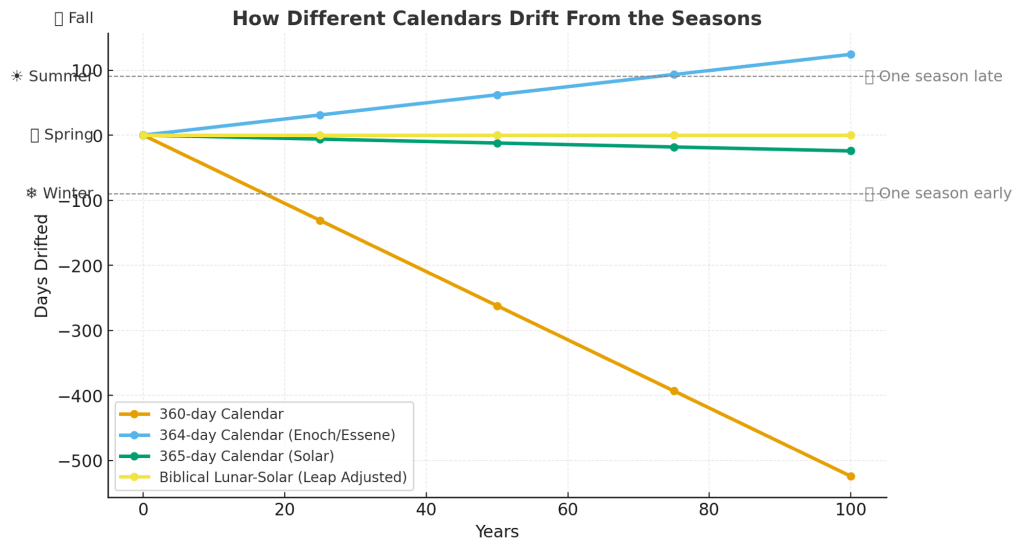
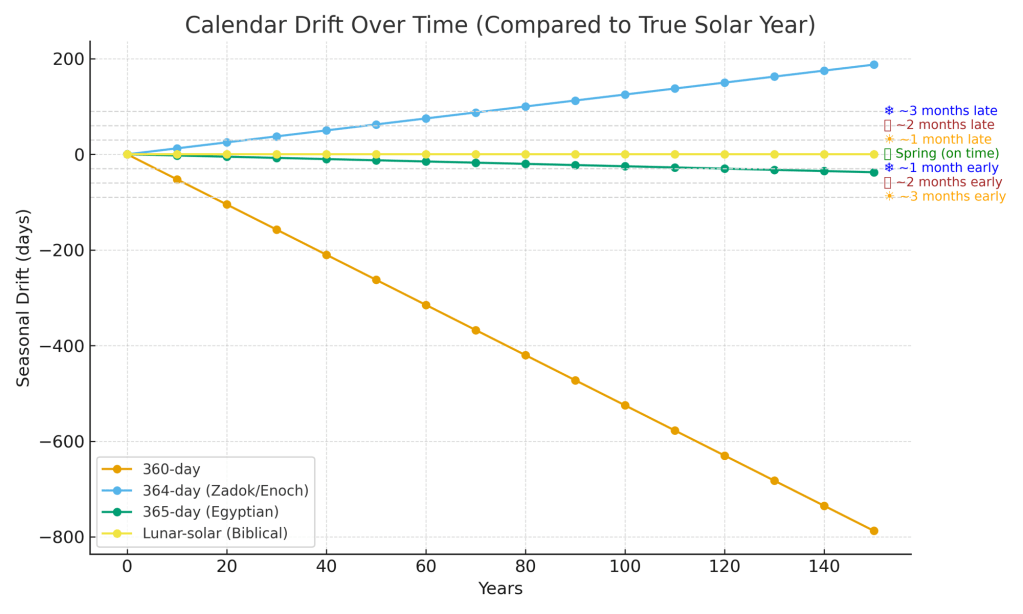
360-day calendar: Will drift about 5¼ days earlier each year. In 72 years, Passover would fall a whole season early.
364-day calendar (Enoch/Essene): Drifts about 1¼ days later each year. In 120 years, feasts shift a whole season.
365-day calendar (Egyptian, Gregorian without leap years): Drifts about ¼ day earlier each year. In 128 years, seasons slip a month.
360 + 5 days (Egyptian fix): Same as 365-day calendar above.
✅ The only system that stays in sync
The biblical lunar-solar calendar (roughly 354 days + “leap month/13th month” when needed) is the only one that continually corrects itself. The leap month keeps the feast days tied to the harvest seasons (Deuteronomy 16:1, Exodus 23:16).
So bottom line:
Solar-only or lunar-only calendars, or fixed 360, 364, 365-day calendars — always drift (seasons shift out of sync).
Biblical lunar-solar (and star watching) — self-correcting with the leap month (every 3 years), keeps the times and seasons in sync.
What About the Zadok (364-Day) Calendar?
Some brothers and sisters ask about the “Zadok calendar”, which is essentially the Enoch calendar, which counts 364 days every year. This calendar is found in the Dead Sea Scrolls, the Book of Jubilees, and 1 Enoch. The Qumran community (who called themselves “sons of Zadok”) might have kept this system because they believed the lunar calendar of the Temple priests was corrupt.
On the 364-day system:
The Zadok calendar year is always exactly 52 weeks (7 × 52 = 364). Every feast day falls on the same weekday each year (for example, Passover always on a Tuesday). It feels neat and orderly — but there’s a major issue.
The problem:
The real solar year is ~365.24 days. That means the Zadok calendar runs 1¼ days too short every year. After 30 years, feast days are a whole month late. After about 120 years, the feasts have drifted a whole season — imagine celebrating Sukkot in the middle of summer or winter 🥵🥶
Did they fix it?
Some suggest that our ancestors may have added a leap week from time to time, others think they simply ignored the drift, keeping the feasts on their fixed weekdays even if the seasons didn’t line up anymore, either way there’s no evidence to test.
Why it matters:
They might have believed that following the 364-day calendar was a sign of covenant faithfulness. But without a correction system, it doesn’t stay in line with the “timepieces in the sky” (Genesis 1:14) — the sun, moon, and stars — which YAH made to mark times and seasons.
So while the Zadok calendar is an interesting historical calendar, it doesn’t solve the problem we talked about above.
The Biblical lunar-solar & star system, with its “13th month/leap month”, keeps YAH’s appointed times in sync with the right harvest seasons year after year.
No Shabbat-Shifting
One last point. We don’t “Shabbat shift,” we don’t shift any of YAH’s weekly cycle days.
YAH’s cycles never change. It doesn’t matter how Rome, Babylon, Egypt, or America name their days & months — our Father’s creation cycle stands.
Some groups (like the Ashkenazim) adjust their calendars for postponements or traditions. But YAH never told us to add, skip, or ignore days. His way is simple:
Days → counted by the sun.
Months → renewed by the new moon.
Seasons → known by the harvests, the sun’s path, and the stars.
Shabbat → the eternal 7th-day rest.
We don’t shift or postpone. We obey YAH’s Instructions (Torah).
We always remember the foundation of our time keeping, by the timepieces YAH created and gave for us to observe, just as Genesis chapter 1 says:
“And Elohim said, ‘Let there be lights (the sun, moon, and stars) in the firmament of the heavens to divide the day from the night, and let them be forsigns and forappointed times, and fordays and years.’”
Genesis 1:14
The lights above us keep YAH’s calendar steady. We only need to look up — not to Rome, not to rabbinic rulings, not to modern inventions — but to YAH’s timepieces in the heavens.
I AM:
Hebrew—by blood
Israelite—by covenant
American—by way of birthright citizenship
Awakened—by The Word & Spirit of YAH
I blog about things that we often all see around us, things that we see in person, online, or on TV— and I offer functional & Scriptural perspectives on such matters. I believe that Scripture is key to understanding this thing we call life:
“ALL Scripture is breathed out by Elohim (God) and profitable for teaching, for reproof, for setting straight, for instruction in righteousness, that the man of Elohim might be fitted, equipped for every good work.”
Timotiyos Bĕt (2 Timothy) 3:16-17 TS2009 https://bible.com/bible/316/2ti.3.16-17.TS2009
And that everything we do in life will be judged by The Creator of life, so it's best to understand the conclusion of The Matter:
“Let us hear the CONCLUSION OF THE ENTIRE MATTER: FEAR ELOHIM AND GAURD (KEEP) HIS COMMANDS, for this applies to ALL mankind! For Elohim SHALL bring EVERY work into right-ruling (judgment), including ALL that is hidden, whether good or whether evil.”
Qoheleth (Ecclesiastes) 12:13-14 TS2009 https://bible.com/bible/316/ecc.12.13-14.TS2009
View more posts
4 thoughts on “Counting Time YAH’s Way: Understanding the Biblical Calendar”


4 thoughts on “Counting Time YAH’s Way: Understanding the Biblical Calendar”