
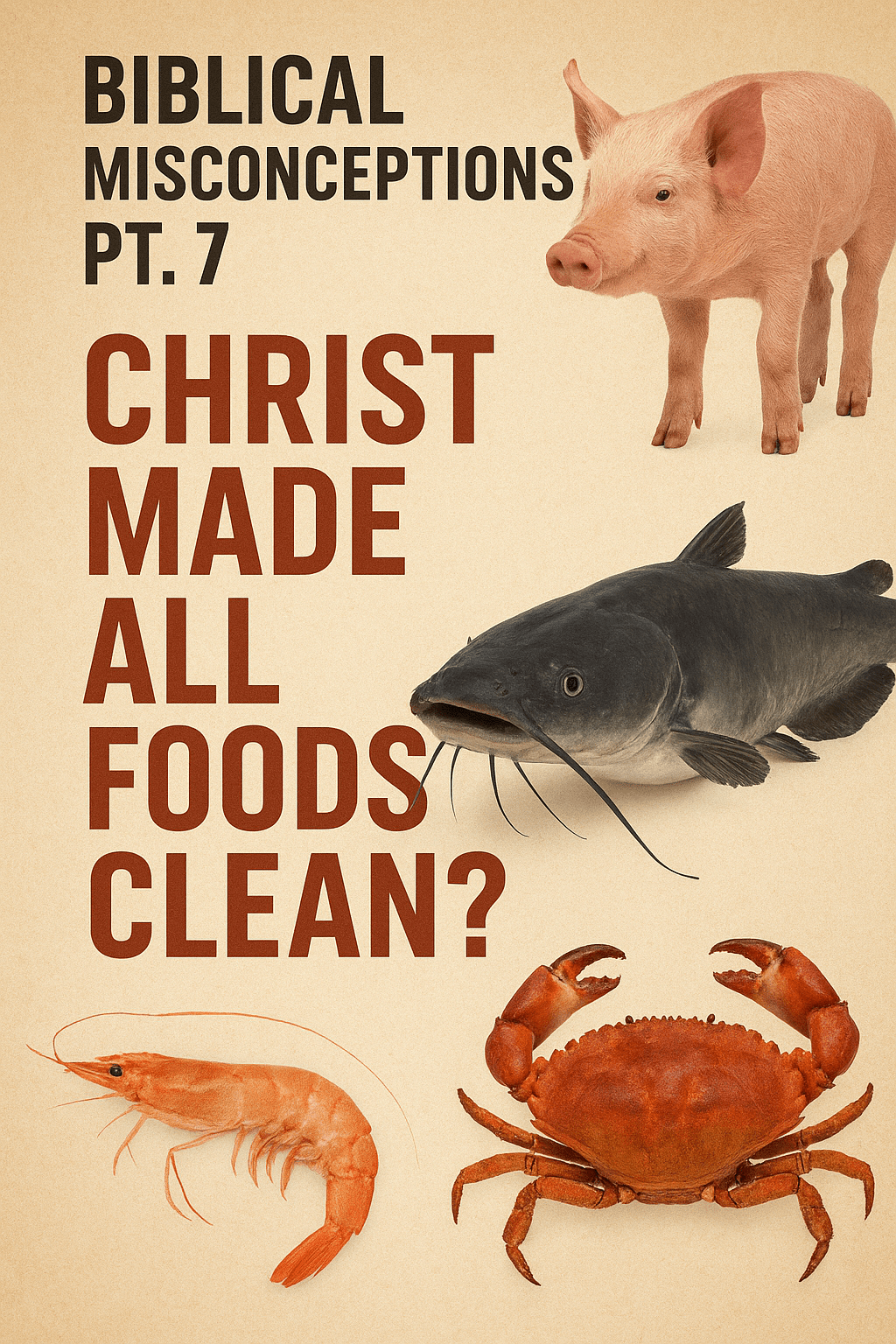
Welcome back to our thought-provoking series where we examine and debunk some of the outright lies and common misconceptions that are told concerning biblical matters. Let us separate fact from fiction as we test modern beliefs held by some against the standards, wisdom, and instructions that are found in the Biblical Scriptures.
I’ve talked about this topic before—sometimes directly, sometimes indirectly—in a few of my other blogs (which I’ll share at the end). But this time, I want to deal with it head-on as part of the Biblical Misconceptions series.
Intro: A Popular But Problematic Saying
One of the most repeated phrases in modern Christianity is:
“Christ made all foods clean.”
For many, that line has become the foundation for eating anything they please — shrimp, pork, catfish, rabbit — you name it.
And if someone challenges it with other Bible verses, the common reply is a partially paraphrased scriptural quote, people often retort with something like:
“Well, we can eat all things with thanksgiving and prayer.”
But here’s the issue: neither of these ideas comes from the actual Scriptures themselves. They come from mistranslations and misunderstandings (in other words as Peter calls it “twisting”) of two key passages — Mark 7:19 and 1 Timothy 4:4–5.
When we look through the lens of Torah, the Hebrew context, and the consistency of The Messiah Yahoshua (who is erroneously called Jesus) & His apostles, we quickly see that The Most High YAH never changed His definition of FOOD!
1. The Mark 7 Paradox
Let’s start with the verse that gets quoted most often.
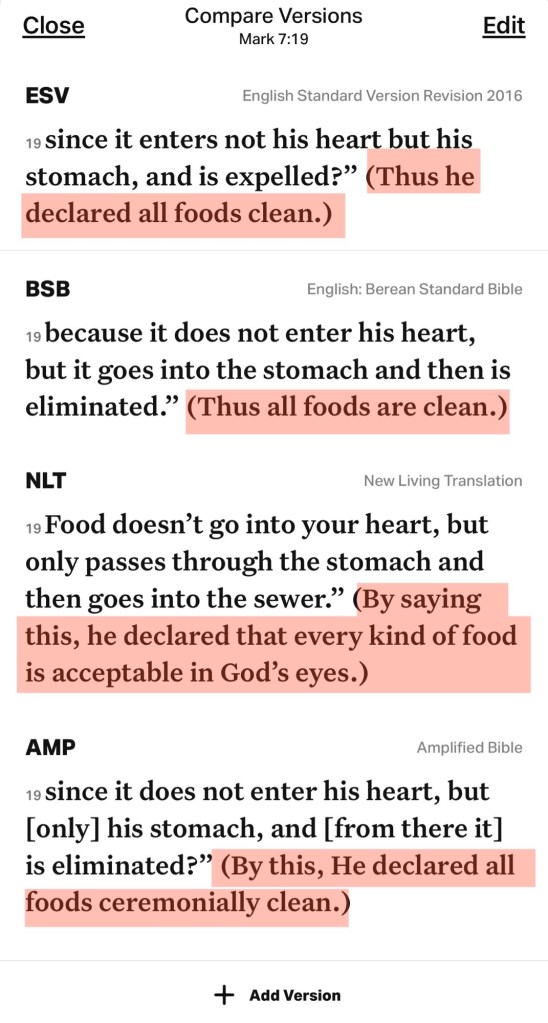
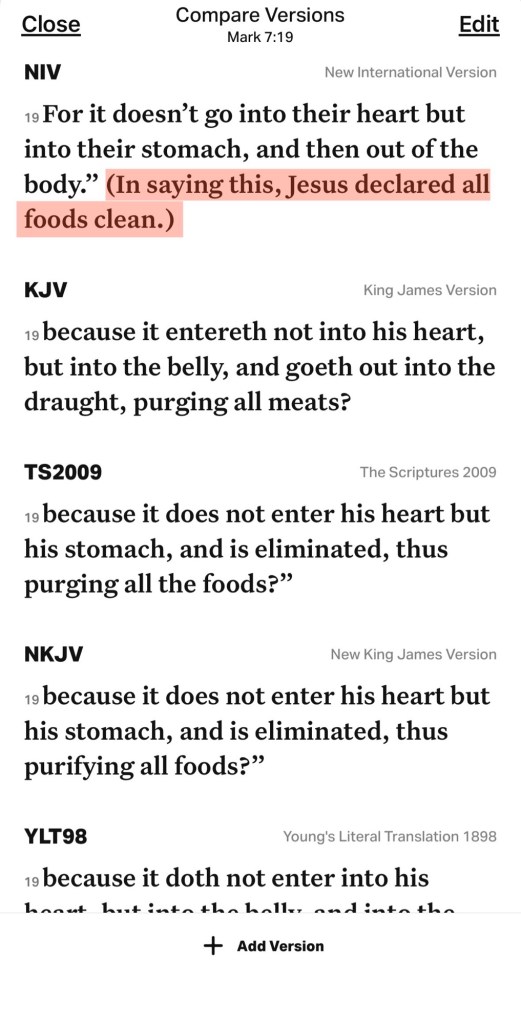
Many English translation Bibles today add a parenthetical note at the end of Mark 7:19:
“(Thus He declared all foods clean.)”
Sounds convincing — until you look at the original manuscripts. That phrase does not exist in the earliest texts, and the translators know it.
It was added centuries later by translators—the lying pen of the scribes at work (see Jeremiah 8:8)—who inserted the claim that Yahoshua made all food clean. By Torah definition, all food is already clean. More on that in a moment. For now, take a look at these screenshots:

So what was actually happening in that passage?
The Pharisees had accused Yahoshua’s disciples of eating bread without washing their hands according to their man-made traditions (Talmud not Torah).
Yahoshua responded by showing them that defilement comes from within a corrupt heart — not from skipping a man-made ritual hand-wash before eating.
He was addressing their tradition and dysfunctional reasoning, not Torah.
Besides… The food in question was bread, not abominable pork chops or shrimp LOL.
Nowhere in that conversation does Yahoshua redefine what food is. Because, the concept of food in Scripture always, and I mean ALWAYS refers to what YAH already declared as “food” by calling it “clean”— and that definition never changed.
2. So, what Is Food According to The Word?
To understand Paul’s later writings, we have to start where Paul started: Torah — The Instructions from YAH, His Word!
Leviticus 11 and Deuteronomy 14 clearly distinguish between clean and unclean animals—food & non-food animals.
YAH didn’t make this distinction for “optional preference” — He made it for our holiness and health, to set His people apart from the nations of the world.
Now, let’s revisit 1 Timothy 4:4–5, which is often misquoted and used as proof that we can eat anything:
“For every creature of Elohim is good, and nothing is to be rejected if it is received with thanksgiving, for it is sanctified by the Word of Elohim and prayer.”
Most people stop at the thanksgiving part, treating the comma as a period, but Paul said it is sanctified (set apart) by the Word and prayer, not by prayer alone.
The Word determines what is set apart — and our prayer acknowledges YAH and His Word and expresses our obedience & gratitude.
In other words, prayer doesn’t make unclean animals clean; it’s our way of giving thanks to YAH for what He already called clean according to Torah and provided for us to eat.
Leviticus 11 and Deuteronomy 14 contain the primary passages that detail how YAH classifies food — nothing else in Scripture ever changes or overwrites that.
3. Paul’s Writings in Context
Paul was constantly battling two extremes — Talmudic twisting on one side, and lawlessness/Torahlessness on the other.
When he talks about ‘foods’ and ‘every creature,’ he’s not saying Torah’s dietary laws are gone. He’s defending believers who are judged for eating what is lawful, simply because of idol sacrifices or man-made rules. Passages like 1 Corinthians 10:25-33, Colossians 2:16-17, and Romans 14:20 make this clear. The issue wasn’t clean versus unclean, but lawful food versus man-made restrictions.
In other words: Paul defends the freedom to eat clean food with a clear conscience, not the freedom to eat unclean meats in rebellion.
Remember all food is clean, and there is no such thing as “unclean food” according to Scripture. Unclean meat is not food—it’s detestable, it’s abominable, according to The Word— and we who obey The Word shall never consume unclean meat, nor consider it food.
People who once ate unclean meat often face criticism from friends and family when they begin eating according to Scripture. That’s exactly what Paul was addressing—he was encouraging believers who eat clean not to let others judge them for doing what’s right.
“Therefore let no one judge you by what you eat or drink, or with regard to a feast, a New Moon, or a Sabbath.”
Colossians 2:16
The same principle applies to keeping the Sabbath day set apart and resting on it as YAH commanded, or rejoicing during His appointed feasts with wine or strong drink, as Torah allows (see Deuteronomy 14:26). Things which many churchgoers today frown upon… But that’s a different topic, for a different blog.
4. Yahoshua’s Example: THE Spotless Lamb
Yahoshua, The sinless, spotless Lamb of YAH — lived without transgressing/breaking Torah.
If He had eaten unclean animals, He would have sinned (1 John 3:4) and could not be our perfect Redeemer.
Even years after His ascension, Peter still said:
“Not so, Master, for I have never eaten anything common or unclean.” Acts 10:14
If the dietary laws had truly changed, Peter would have known—and he wouldn’t have even mentioned unclean meat. After all, if “all animals were clean,” there’d be no reason for him to distinguish between clean and unclean in the first place. You see the logical fallacy there, right?
But even after the vision, he clearly understood that it was about people, not food:
“Elohim has shown me that I should not call any man common or unclean.” (Acts 10:28)
Yahoshua’s blood doesn’t purify unclean animals and turn them into food—it purifies unclean people from their sin/breaking of Torah.
5. It’s Obedience to The Word That Truly Cleanses
Yahoshua said,
“You are already clean because of the Word I have spoken to you.” (John 15:3)
That’s the real cleansing power — obedience to the Word, not redefining it. Torah (The Word) still draws the line between holy and unholy, clean and unclean.
To “walk as He walked” (1 John 2:6) means walking as Yahoshua did — in obedience to The Word of YAH.
6. Receiving With Thanksgiving
So yes, again — we should always give thanks to YAH for our food, but only for what YAH calls food.
We should NOT pray over unclean meat and think we’re receiving a blessing, as if YAH would turn what He calls detestable into ‘nourishment for our bodies’—that’s not grace. Likewise, we must not offer prayers that YAH calls abominable while thinking we are clean, for that kind of prayer is an abomination in His sight (Proverbs 28:9). Let’s honor YAH with both our prayers and our plates.

Paul’s statement in 1 Timothy 4 makes perfect sense when we understand that The Word of YAH has already sanctified which animals are clean—as food—from those that are unclean—as non-food. The preceding verse, 1 Timothy 4:3, gives the additional proper context: in Paul’s day (as in ours), some were teaching that one must be a vegetarian to be righteous. But as Paul said, ‘we believe and know the truth’—YAH has given us clean meats to eat as food according to His Word, no matter what anyone else claims.
Remember: Our prayers for and “over” our food do not cleanse abominations, but they are part of a righteous cycle of receiving, reverence, and thanksgiving.
Conclusion: Returning to YAH’s Instruction/Torah & Protein Options
Hopefully you now fully understand how the teaching that “Christ made all foods clean” is a modern Biblical misconception that is rooted in mistranslation and doctrinal manipulation.
YAH’s Word has always defined food and non-food for us. And His definition hasn’t changed — because He hasn’t changed and He doesn’t change (Malachi 3:6).
So when you sit down to eat, give thanks — not just with your mouth, but with your obedience. Let your meal be sanctified both by The Word and by your prayer, just as Scripture says. Because true thanksgiving begins with honoring what YAH has already called good, and obeying Him over any other doctrine or word.
Always remember the end-time judgment prophecy in Isaiah 66:17 and the judgment that will come upon those who eat abominable, unclean meats.
Eat what the Creator of all—our Father in Heaven—calls food, and turn away from what He does not call food—today! Your salvation depends on it. Just as the first sin began by eating what YAH commanded against in the Garden, remember: ALL SINS MATTER! Pork and shellfish will kill you, and you will face the second death and certainly die if you continue to choose to eat them after reading The Word.
Until next time, shalom ✌🏾
~Yahrahn
Like, comment, share, and subscribe
If you would like to donate:
Cash App: $Yahrahn https://cash.app/$Yahrahn
PayPal: @Yahrahn https://www.paypal.me/Yahrahn
And be sure to check out some of these other blogs on biblically clean eating:

One thought on “Biblical Misconceptions Part 7: Did “Christ Make All Foods Clean”?”