
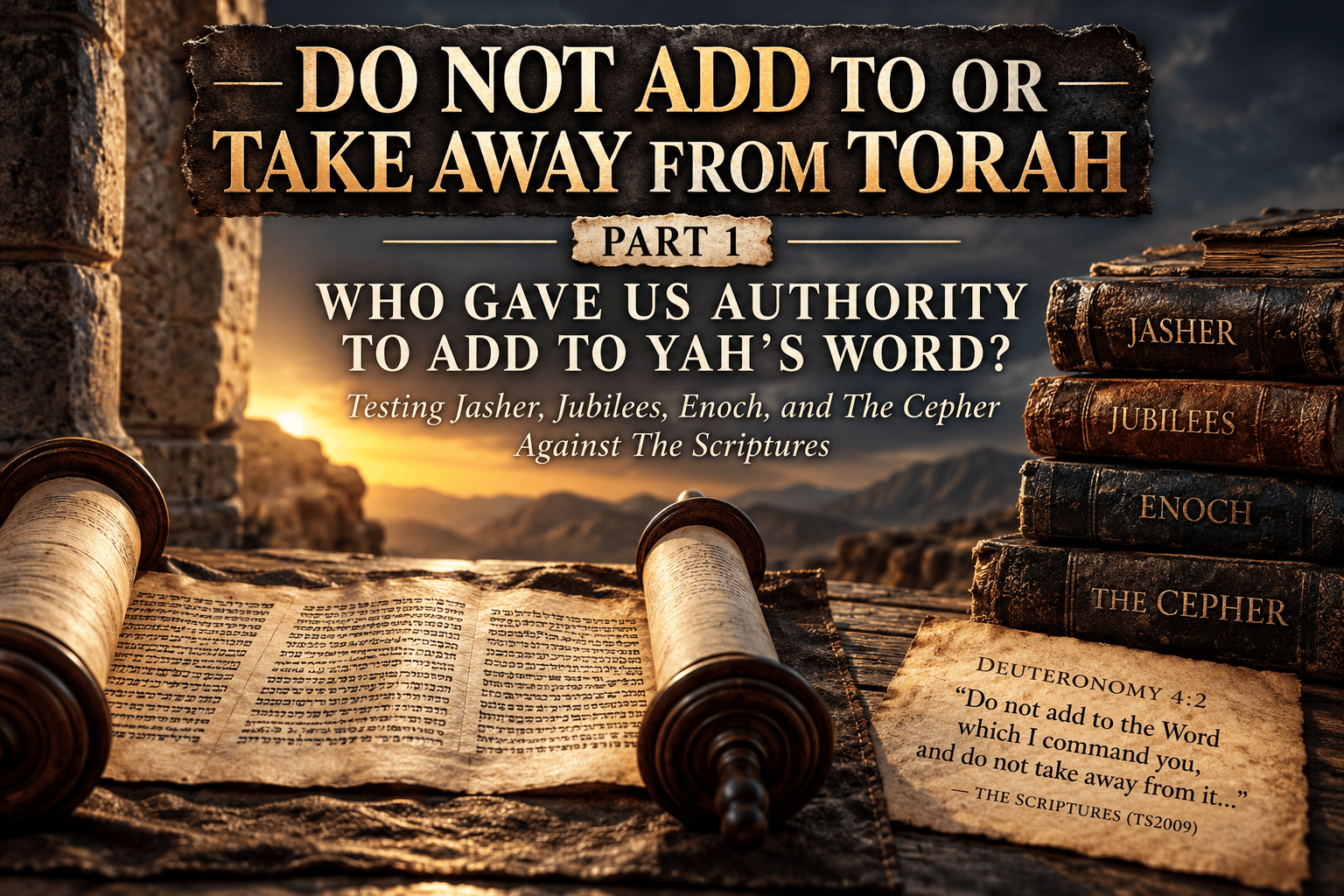
Testing Jasher, Jubilees, Enoch, and The Cepher Against The Scriptures
There is something I’ve been thinking about for a while now, and the deeper I look into it, the more concerning it becomes.
Many of us, especially within the Hebrew Israelite awakening, have spent years unlearning religious traditions, questioning doctrines, and returning to the original instructions (Torah) of The Most High YAH. We’ve learned the importance of distinguishing between what YAH actually commanded and what men have added through religious traditions and interpretations.
But here’s something I believe we need to consider just as seriously:
Have we become so eager to recover lost or hidden Scriptures, that we’ve accepted additional commandments, narratives, lessons, and historical accounts, simply because they’re found in books that claim to be or are presented as being just as ancient or inspired by YAH, as the rest of The Bible?
And what happens when extra-Biblical writings attribute instructions to YAH that differ from what we find written in Torah?
That’s what I want us to examine in this series.
First, What Did YAH Actually Command?
Let’s begin with a very important, foundational instruction in Torah:
“Do not add to the Word which I command you, and do not take away from it…”
Deuteronomy 4:2, The Scriptures (TS2009)
Understand the purpose of that commandment. We are not to add to or diminish/subtract from His Word, so that we may properly guard and obey the commandments YAH has given us. And for good measure, and so we cannot easily overlook its importance, Moses repeats the instruction in Deuteronomy 12:32.
So it is clear — We have no authority to turn our own traditions, interpretations, or additional doctrines into commandments from YAH.
Now, this doesn’t mean that every instruction recorded after the writings of Moses is automatically invalid — after all, the rest of the Bible contains further instructions, lessons, and prophetic revelations. Nor does it mean that any book containing information not found in Torah must be false. But it does mean that we must be extremely careful when another book claims that YAH established a foundational command or instruction, and we do not see the same written in Torah. Especially when that supposed command cannot be reconciled with what Torah actually teaches.
Always Remember What The Messiah Said About Moses
In John 5:46–47, Yahoshua HaMashiach tells us:
“For had you believed Moses, you would have believed Me: for he wrote of Me. But if you believe not his writings, how shall you believe My words?”
Think about that!
Moses wrote of The Messiah!
From the promised seed in Genesis 3:15, to the prophetic blessing concerning Judah in Genesis 49, to Passover and the Exodus, the sacrificial system, and the promised Prophet in Deuteronomy 18, we find a testimony that ultimately points toward The Messiah Yahoshua.
And after His resurrection, where did Yahoshua begin when explaining The Scriptures concerning Himself?
Luke 24:27 tells us:
“Beginning at Moses…”
He then continued through the prophets, explaining the things concerning Himself. Yahoshua affirmed the writings of Moses as trustworthy testimony concerning Himself. He did not teach His disciples to disregard Torah in favor of later writings. He didn’t say that Moses didn’t tell the full story or that Moses didn’t tell it correctly. Luke doesn’t say, “Beginning at Jasher, Jubilees, or Enoch”, but “Beginning at Moses…”
And Paul reminds us in 2 Timothy 3:16–17 that Scripture is inspired by Elohim and profitable for teaching, reproof, correction, and instruction in righteousness. So, when another writing claims to preserve additional revelation from YAH, shouldn’t we test that claim against the testimony already established in Scripture?
This Is Where Jasher, Jubilees, and Enoch Enter the Discussion
Every year, more Hebrew Israelites begin reading extra-Biblical writings outside the standardized collections of books as found within most Protestant 66-book Bible.
And let me be clear: I’m not opposed to reading, studying, and testing other books, especially if they are said to be ancient Hebrew Israelite writings. I in fact, value many of the writings commonly called the Apocrypha, such as the books of Sirach, and the Maccabees. But we must also understand that the Apocrypha and Pseudepigrapha categories, are not interchangeable categories.
The Pseudepigrapha is a broad scholarly classification that includes writings associated with Biblical figures, such as Enoch, Jasher, Jubilees, and the Testaments of the Twelve Patriarchs. Their origins, manuscript histories, and acceptance as Scripture is muddled and debated. For example, Jubilees and Enoch are ancient writings preserved in part among the Dead Sea Scrolls, and both are included in the Ethiopian Orthodox Bible, while the Catholic Bible includes the apocryphal but not the pseudepigraphal books.
Also, today’s commonly circulated Book of Jasher, has a much later documented history. Do not assume it is the same Book of Jasher mentioned in Joshua 10:13 and 2 Samuel 1:18 simply because the titles match. We must understand that simply attributing a book to a Biblical person, doesn’t establish that the person actually wrote it.
Again, here’s a point:
Ancient does not automatically mean inspired. And additional information does not automatically mean greater truth.
We must be willing to examine each writing on its own merits.
So, What Happens When These Writings Claim to Give Us YAH’s Commandments?
Let’s get to the heart of this investigation.
Some of these writings don’t merely provide additional narrative details or elaborate upon events recorded in Torah. They present laws, judgments, lessons, and instructions as though they were established and/or approved of by YAH Himself.
Consider for now, just a few examples:
Jubilees 30:7–11 introduces capital punishments associated with Israelites giving their daughters or sisters in marriage to foreigners, presenting these regulations as established upon heavenly tablets.
Jubilees 50:8–13 contains additional Sabbath prohibitions, including restrictions concerning travel and marital intimacy, punishable by death.
Jubilees 6:29–38 commands Israel to observe a 364-day calendar and warns against reckoning the year through lunar observations.
And 1 Enoch 72–82 presents a related heavenly calendrical system, revealed through an angel.
Now, I’m not asking anyone to take my word that these passages violate Torah. That’s what we need to examine. But I do want you to recognize something:
These are not simply additional stories about Abraham, Noah, Moses, or the patriarchs. These are claims involving divine instructions and heavenly authority.
And when such claims differ from what YAH has already commanded, we cannot simply overlook the difference because the writing is ancient, interesting, or found among the Dead Sea Scrolls. We must test them.
How Will We Determine What’s True?
We need to be fair and precise. Because, not every difference is a contradiction. Not every additional detail is fabricated. And not every interpretation we agree or disagree with is necessarily a violation of Torah.
Throughout this series, we’ll distinguish between:
Additional information: A writing supplies historical details that Scripture does not record. Those details may be worth investigating, but their absence from Torah doesn’t automatically establish whether they’re true or false.
Additional instructions or interpretations: A writing introduces religious requirements, judgments, or explanations and presents them as authoritative. We must examine whether they are supported by Scripture or go beyond what YAH commanded.
Direct contradictions: A writing explicitly teaches something incompatible with a command or account established in Scripture. When the claims cannot reasonably be reconciled, we have a genuine conflict — and when light shines on a work of darkness, we then expose and rebuke it.
And let us always remember to ask this important question:
Does the writing merely describe someone’s actions, or does it claim that YAH Himself commanded or approved of them?
You can see how that matters right? Our responsibility isn’t to nitpick, conflate, or manufacture contradictions, but neither should we explain them away merely because we like a particular extra-Biblical book.
And What About The Cepher?
I understand why so many Hebrew Israelites appreciate The Cepher. I purchased one early in my Hebrew awakening and even gifted copies to others. Its use of Hebrew names and terminology, combined with its inclusion of additional ancient writings, makes it appealing to those seeking a deeper understanding of our Biblical heritage.
But including more books does not automatically make a Biblical collection more complete, functional, or authoritative. And restoring Hebrew names and terms doesn’t automatically make every translation or interpretation correct.
The Cepher not only includes the apocryphal books, but it also includes the pseudepigraphal books of Jasher, Jubilees, Enoch, alongside the more familiar books of Scripture. Therefore, we must consider not only the accuracy and authority of those additional writings, but also The Cepher’s own translation decisions.
The question here, isn’t whether The Cepher contains insightful material. The question is whether the authority being given to all of its contents is justified.
Hopefully you can already see why that deserves careful examination.
Let’s Prove All Things
I want to make something very clear as we begin. I’m interested in what is true according to The Word of YAH. If Jubilees preserves something accurate, let’s acknowledge it. If Jasher contains an account that can be historically supported, let’s examine it. If Enoch offers insight into ancient righteous ways, let’s study it.
But, if any of these writings claim that YAH commanded something contrary to what we read in His Torah, we need to be ready to identify and expose that conflict. If any of these writings change the established narrative we find in the historical accounts recorded in Torah, we need to be ready to identify and expose that conflict.
We cannot reject man-made traditions in Christianity or Judaism for adding to and subtracting from YAH’s Word, while embracing other additions, subtractions, or any other falsehoods from pseudepigraphal writings, just because they have become accepted by Israelites worldwide. That would be inconsistent, wouldn’t it?
Remember Paul’s instruction:
“Prove ALL things; hold fast that which is good.”
1 Thessalonians 5:21
So that’s exactly what I (and hopefully you) intend to do. Test and prove, then hold on to what is good, functional, and true, and expose and reject that which is dysfunctional, false, and evil.
In Part 2, we’ll begin with Jubilees, examining some of its strongest claims involving marriage laws, capital punishments, Sabbath restrictions, and the calendar. We’ll compare what Jubilees claims YAH commanded, with what Moses actually recorded in Torah. And we’ll let the evidence speak.
Because the goal is not to possess the most books, the oldest manuscripts, or the most fascinating collection of stories. Our goal is to know The Truth, guard YAH’s commandments, and never give the traditions or writings of men authority over His Word.
Hope to see you in part two…
Until next time, shalom ✌🏾
~Yahrahn
Like, comment, share, and subscribe
If you would like to donate:
Cash App: $Yahrahn https://cash.app/$Yahrahn
PayPal: @Yahrahn https://www.paypal.me/Yahrahn
