
Testing Jasher, Jubilees, Enoch, and The Cepher Against The Scriptures
In Part 1, we established our foundational instruction from Deuteronomy 4:2: We are not to add to or take away from the Word YAH commanded us to guard and obey.
We also established that a writing being ancient, containing additional Biblical history, or claiming heavenly revelation does not automatically make it inspired Scripture. So now, let’s put that standard to the test.
The Book of Jubilees contains fascinating accounts of the patriarchs and events recorded in Torah. But it also presents additional commandments, statutes, and judgments as though they were given to Moses by YAH, while also being supposedly written upon heavenly tablets. And here’s where things become concerning.
What happens when those additional commandments, statutes, and judgments differ from what YAH actually instructed in Torah — what happens when these books do not line up with The Word of YAH?
Let’s compare the evidence.
(And to encourage you to highlight these verses in your own Bibles, and to keep this as concise as possible, I will mostly reference the Bible verses and passages instead of typing them as we continue.)
1. Additional Marriage Laws and Capital Punishments
Compare Jubilees 30:7–16 with Deuteronomy 7:1–4 and 21:10–14.
Jubilees 30, like Genesis 34, speaks about the defilement of Dinah, and then her brothers’ slaughter of the men of Shechem. Jubilees also gives Dinah’s age as 12, a detail not recorded in Torah. But more importantly, verse 7 introduces something else: a commandment prohibiting Israelites from giving their daughters or sisters in marriage to any foreigners. And the prescribed punishment is what?
The death penalty. Death by stoning for the man who gives her in marriage, and death by burning for the woman who marries a non-Israelite!
Jubilees 30:9 claims these judgments were established upon heavenly tablets. Verse 11 then instructs Moses to command Israel not to give their daughters to foreigners or take foreign women for their sons. Now — Wait a minute! Let’s further compare this so-called commandment with Torah:
Deuteronomy 7:1–4 specifically prohibits intermarriage, yes, but only with the seven Canaanite nations listed in that passage, warning that such unions would turn Israel toward serving other gods/mighty ones. (Solomon showed us all too well how that can play out 1 Kings 11: 1-11)
However, Deuteronomy 21:10–14 also provides instructions permitting Israelite men to marry foreign women taken captive during war, under specific conditions. So clearly, Torah does not establish an unconditional prohibition against every marriage involving someone of foreign descent.
So where does Torah command: that an Israelite man be stoned for giving his daughter or sister in marriage to a foreigner; or that a woman be burned, simply for entering into such a marriage?…
It doesn’t. There is no judgment that prescribes those punishments for that offense.
Now, I’m not suggesting that YAH was unconcerned about whom His people married. He certainly warned Israel against marriages that would lead them into idolatry. And in Leviticus 21: 7 & 13-15, YAH even gave priests additional restrictions concerning whom they could marry. But that is not the question. The question is:
Who gave another writing the authority to broaden YAH’s restrictions and introduce additional capital punishments in His Name?
That is a serious issue under Deuteronomy 4:2.
2. Did YAH Account Simeon and Levi’s Slaughter as Righteousness?
Compare Jubilees 30:3–6, 17–23; Genesis 34; and Genesis 49:5–7.
Let’s return to Dinah’s account, because there’s another significant difference. Again, Genesis 34 records how Shechem violated Dinah and how her brothers responded. The sons of Jacob collectively deceived the men of Shechem into agreeing to circumcision. Then Simeon and Levi attacked them while they were in pain & weakened, killing the males of the city, then their brothers subsequently plundered it. Jacob was troubled by his sons’ actions and the danger they brought upon his entire household.
But Genesis doesn’t leave the matter there. Years later, as Jacob approached death, he addressed both Simeon and Levi again. In Genesis 49:5–7, Jacob condemns their violence, fierce anger, and cruel wrath. He even declares that they would be divided and scattered in Israel.
Now, what does Jubilees tell us?
Jubilees 30:6 claims that YAH delivered the men of Shechem into the brothers’ hands to execute judgment. Verse 17 continues, declaring that their slaughter was reckoned unto them as righteousness and recorded in their favor. Then verses 18–20 associate Levi’s supposed righteous vengeance with the reason for the selection of his descendants for the priesthood, even describing heavenly records testifying to his righteousness.
Do you see the difference?
Genesis records Jacob condemning their fierce anger and cruel wrath. Jubilees presents their slaughter as righteous judgment credited to them in heaven!
Now, to be fair, condemning their anger doesn’t mean that Jacob condemned every aspect of their response to Dinah’s violation. But neither does that give permission to declare the entire slaughter righteous.
And here’s another concern: Torah records YAH selecting Aaron and his sons for priestly service in Exodus 28 and 29, and later records the Levites’ faithfulness during the golden-calf incident in Exodus 32:26–29. Yet Jubilees 30 places Levi’s vengeance at Shechem at the center of its explanation for his priestly selection. That is an additional claim of divine approval and heavenly recognition that Torah itself does not establish nor acknowledge.
3. But Wait… What About the Covenant Sign They Used?
There’s another part of this account that I believe deserves serious consideration. Let’s remember Genesis 17:9–14, where YAH established circumcision as a sign of His everlasting covenant with Abraham and his household.
Now fast-forward back to Genesis 34. What did the sons of Jacob do with that very sign? They used circumcision as part of their agreement, convincing the men of Shechem that if they also became circumcised and took the sign of YAH’s covenant in their flesh, that the two peoples could intermarry and dwell together. But just as the brothers deceptively planned, while the men were recovering and weakened, Simeon and Levi attacked and slaughtered them. So much for the promised peace and unity!
Think about that! The sign which YAH established to represent His covenant was deliberately used to weaken and destroy the men of an entire city. Something given as a covenantal sign in the flesh became a means of marking and weakening people for death.
Now, before anyone misunderstands me, I’m not excusing Shechem’s wicked treatment of Dinah — ever! Nor do I think that her father Jacob did either. But does one wicked act justify another? And does vengeance give anyone permission to misuse something YAH established for a set-apart purpose? Remember, Genesis 17 also commanded circumcision for males brought into Abraham’s household who were not his biological descendants; it was never presented as a weapon against foreigners.
And this is where the additional writings become particularly troubling. Jubilees 30 credits the slaughter as righteousness.
But Jasher 33:37–52 goes even further!
Jasher also describes Simeon devising the circumcision strategy specifically to weaken the men before attacking them. Then verse 52 attributes Simeon’s counsel to YAH Himself! Now, wait another minute! It’s one thing for Scripture to record that men misused something YAH commanded. It’s another thing entirely for an additional writing to claim that YAH Himself was behind the counsel used to accomplish it.
We’ll examine Jasher more thoroughly in Part 3. But for now, I want us to consider how seriously we should question any writing that attributes such actions to YAH.
The brothers did not rewrite the commandment of circumcision. They exploited its intended purpose. And we should not casually accept another writing’s declaration that their deceptive strategy and slaughter were authorized and approved of in Heaven.
4. Additional Sabbath Laws — Punishable by Death?
Compare Jubilees 50:6–13 with Exodus 20:8–11; 31:14–15; and 35:1–3.
Now, let’s examine something especially important to those of us who guard the Sabbath (Shabbat). Torah commands us to keep the seventh day Shabbat set-apart and cease from work (Exodus 20). And Exodus 31:14–15 does in fact prescribe death for profaning the Shabbat through prohibited work.
But notice what Jubilees adds… Jubilees 50:8 includes prohibitions against marital intimacy, drawing water not prepared on the sixth day, and certain journeys. Verses 12–13 add further restrictions, including riding animals, traveling by ship, hunting, fishing, fasting and engaging in warfare.
And what punishment does Jubilees prescribe for these offenses?
The Death penalty!
Now, hold on… Where does Torah command that a husband and wife cannot have marital relations on Shabbat under penalty of death? Leviticus 15:16–18 does explain that a bodily emission, including those during marital relations, results in temporary uncleanness until evening, with washing required — But being temporarily unclean is not the same as being sinful, and Torah does not prescribe the death penalty for lawful marital intimacy. And where does Torah establish a death penalty simply for drawing water that wasn’t prepared the previous day? Or sailing on the Shabbat? Or fasting?…
Didn’t Moses fast for 40 days (twice — Deuteronomy 9:9 & 9:18)? And what about The Messiah fasting for 40 days (Matthew 4:1 & Luke 4:1-2)? Did Moses, and most importantly, did The Messiah disobey the supposed command from YAH as instructed in Jubilees 50, by fasting on the Shabbat? Did The Messiah sin and disobey YAH when He fasted on those Shabbat days? YAH forbid, of course not!
Certainly, some of the activities listed in Jubilees could involve work already prohibited by Torah. And Jubilees does acknowledge an exception for the sanctuary offerings commanded on the Sabbath.
But we cannot assume that every additional restriction is a commandment from YAH, especially when violating that supposed command carries the penalty of death.
Jubilees isn’t merely recommending these practices as additional ways to guard the Shabbat. It presents them as commands and judgments revealed to Moses from YAH. And that once again brings us right back to Deuteronomy 4:2. I ask again: Who has the authority to declare additional activities punishable by death in YAH’s Name? That’s not something we can overlook simply because we agree that the Shabbat day must be guarded.
Let’s keep moving with the time…
5. Who Established the 364-Day Calendar?
Compare Jubilees 6:29–38 with Genesis 1:14; Exodus 12:2; Leviticus 23; Numbers 10:10; and Psalm 104:19.
Now here’s another major concern, particularly for those of us who observe YAH’s appointed times. Jubilees 6:32 commands Israel to reckon the year according to exactly 364 days, presenting this as a complete year established by divine authority. Verses 35–38 then warn that those who depart from this reckoning will confuse YAH’s appointed times. Verse 36 specifically criticizes reliance upon observations of the moon.
But let’s consider what Torah actually teaches. Genesis 1:14 establishes the heavenly luminaries (sun, moon, and stars) for signs, appointed times, days, and years. Exodus 12:2 establishes the beginning of Israel’s year. Leviticus 23 identifies YAH’s appointed times and the days of their observance. And Psalm 104:19 specifically associates the moon with appointed times.
Now, Jubilees itself refers to new moons earlier in chapter 6, so we shouldn’t pretend the book never acknowledges them. However, it insists upon a fixed 364-day calendar while criticizing lunar observations that result in a different reckoning of months and years.
Here are some questions: Where does Torah command Israel to observe a year consisting of exactly 364 days? And, where does Torah forbid using observations of the new moon to determine the beginnings of months? Do you find that anywhere in Scripture?
On the contrary, when we look for instance, at the end of Isaiah, chapter 66 verse 23, we see that new moons, like Shabbat days will still be a part of reckoning the passing of months and years.
I will acknowledge that Torah doesn’t provide one passage explaining every detail of the new moon’s first-visible-crescent method. That understanding can be examined through the wider Scriptural study. But that certainly does not mean that Jubilees’ particular calendar is correct or Biblical.
And there is another concern. A 364-day year does not equal the actual solar year either, which is approximately 365¼ days. Without some means of addressing the difference, the Jubilees calendar would gradually shift against the seasons. That matters immensely because several of YAH’s appointed times are connected with the agricultural and harvest seasons. For more on that see this blog on the matter:
No matter how people debate or use the Jubilees calendar, this point remains:
Jubilees commands a particular calendrical system and attributes that requirement to a command from Heaven, despite Torah establishing the heavenly luminaries (the sun, moon, and stars) as signs that tell us the times.
And rather than assuming that the calendars presented in Jubilees or Enoch are correct simply because these writings claim heavenly revelation, whether through an angel or heavenly tablets, shouldn’t we test those claims against Scripture and the heavenly luminaries YAH established for signs and appointed times? Meditate on Genesis 1:14.
Again, for more on this matter see https://whatishebrewing.com/2025/08/27/counting-time-yahs-way-understanding-the-biblical-calendar/
So, What Have We Established?
Some of Jubilees’ teachings agree with Torah. Others may offer information worth studying. While others work against Torah. Agreeing with Torah in some places does not automatically establish the divine authority of everything else it teaches. And being ancient and found in the Dead Sea scrolls certainly doesn’t give any writing permission to add commandments, punishments, or interpretations in YAH’s Name. After all, a simple Google check will allow you to see that other non-Scriptural writings were found in the Qumran caves too.
So, let us remember the instruction that started this entire series:
“Do not add to the Word which I command you, and do not take away from it…”
Deuteronomy 4:2
Remember, we cannot reject man-made religious doctrines for adding to and subtracting from YAH’s commandments, only to embrace additional commandments and teachings from another writing without fully testing them.
And let’s remember something else:
Our goal is not to prove that every word in Jubilees is false. Our goal is to determine whether its claims of divine authority withstand Scriptural examination.
If something is true, we should acknowledge it. If something remains uncertain, we should say so. And if something contradicts what YAH has established, we should be ready and willing to identify and expose that conflict.
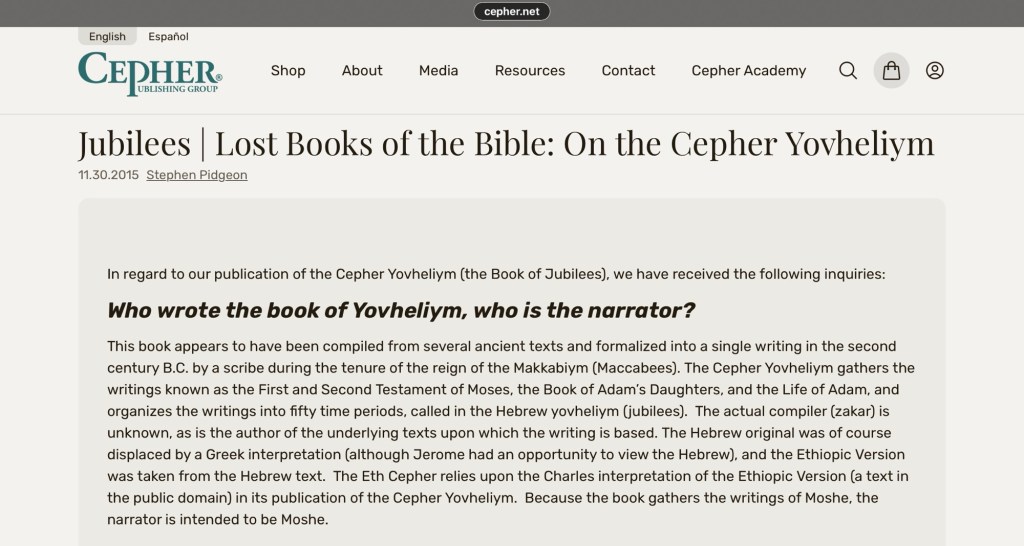
And here’s one final question worth considering: Who actually wrote Jubilees? Although the book presents itself as revelation given to Moses, even The Cepher’s publisher acknowledges that its compiler is unknown. So what evidence establishes that its additional commandments genuinely came from YAH through Moses?
Coming Up in Part 3…
Next, we’ll examine Jasher and Enoch more closely.
We’ll revisit the slaughter at Shechem and Jasher’s claim concerning Simeon’s counsel. We’ll also examine Jasher’s expanded account of Moses’ life and some of Enoch’s claims concerning heavenly revelation and the calendar. Again, there’s nothing wrong with studying and testing ancient writings. But we must never confuse a writing claiming to speak for YAH with a writing whose divine authority passes the test.
As Paul instructed:
“Prove ALL things; hold fast that which is good.”
1 Thessalonians 5:21
And let’s also remember what John instructed:
“BELOVED, DO NOT put faith in every spirit, but prove (test) the spirits to discover whether they proceed from YAH; for many false prophets have gone forth into the world.”
1 John 4:1
Until next time, shalom ✌🏾
~Yahrahn
Like, comment, share, and subscribe
If you would like to donate:
Cash App: $Yahrahn https://cash.app/$Yahrahn
PayPal: @Yahrahn https://www.paypal.me/Yahrahn
